Autonomy through tangible objectives - Cyril Morcrette (Mappy.com)
Mappy provides maps, route planning and address guide services to plan your journeys on all roads all over Europe.
- Founded: 1987 on Minitel, became Mappy in 2000. Part of SoLocal Group.
- Company size: 75 employees and 25 external
- Tech team size: 65, split between 10 teams (front, back, cartography, big data…)
- Traffic: 350 Million UVs per month, spikes at 1M requests per minute
What’s on your pizza?
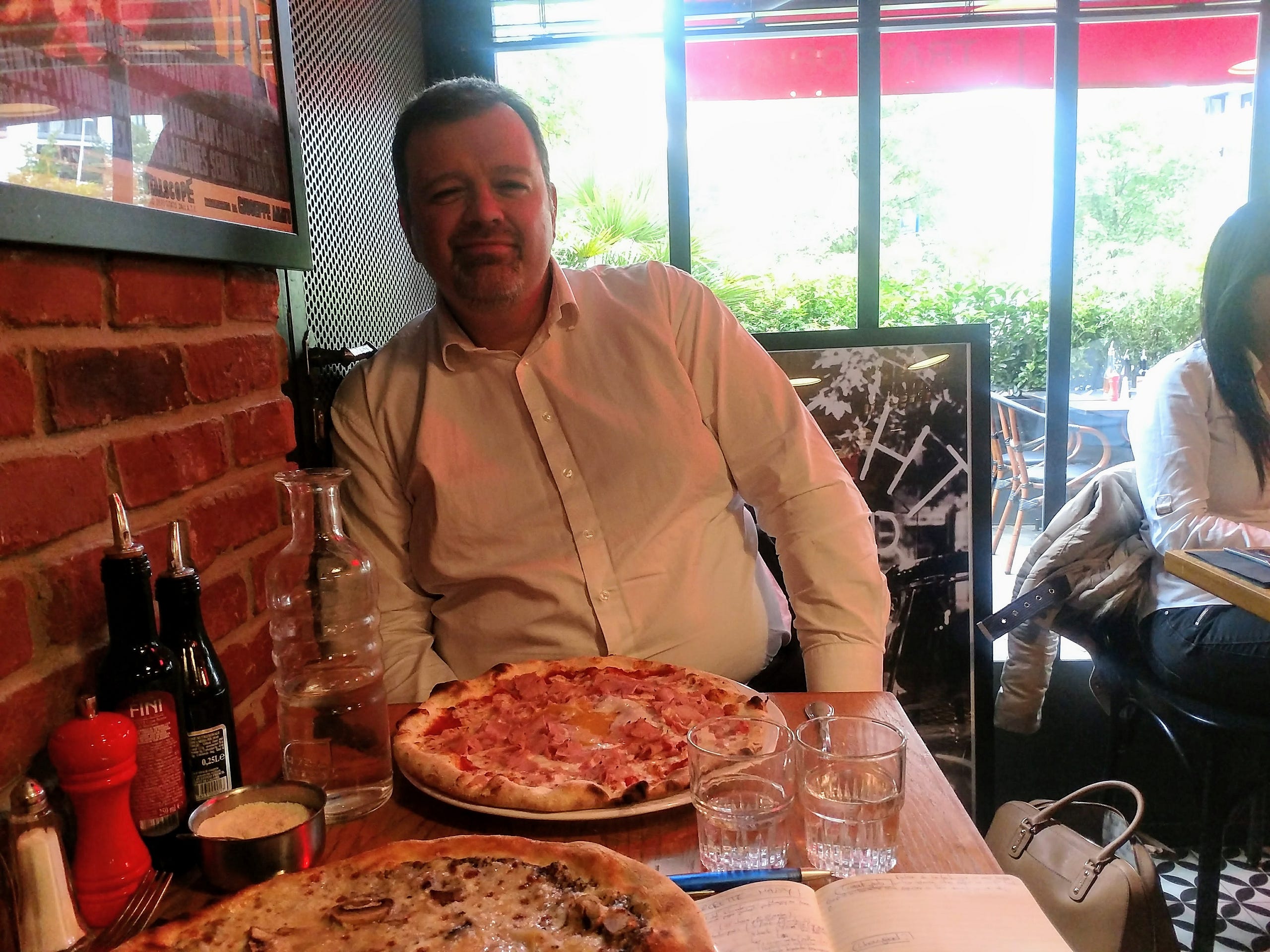
Pizza Bismarck (cheese, speck, egg) at Tribeca District in Boulogne Billancourt
Mappy is part of a big corporation and not really a startup, let’s see the difference.
About you
I’m basically the turning point between the small company Mappy and the big corporation that owns it
Can you tell us a bit about your background?
I’ve been driving tech projects for about 20 years now. I studied systems and networking at EPITA then went to the MIT where it worked out well with the lab I was working in, so I stayed to get a degree there.
I met there somebody from Polytechnique with whom I started Ukibi, a universal address book. We raised money and survived for 4 years, and I ended up moving back to France to start an office there. We make a lot of beginner’s mistakes, which was quite normal in the end. With the explosion of internet, nobody wanted to pay for an online service anymore, so it got hard for us to make money. We got bought, and I stayed for about a year in the new group.
I then moved to SFR to modernize the web portal for all the Vodaphone services, including mobile data. I got poached to head the digital team at Lagardère Group at Newsweb where I had to scale a few magazine’s websites to millions of UVs per month and develop all applications around it — even one of the first iPad app.
There were 14 sites total, with very big ones in the portfolio. I had a team of about 100 developers and 10 designers, and we had some really interesting challenges to tackle like to to render a radio show in text for SEO purposes, etc.
A former director at Lagardère then called me back to make Mappy move on the tech side, as it was quite asleep. It’s now been 7 years !
Can you describe your job? What does it mean to be CTO at Mappy?
I head the company’s technology in a wide way. I’m the man in the middle between defining tech orientations and managing budgets. We give a lot of autonomy to the teams by giving them tangible objectives.
I’m basically the turning point between the small company Mappy and the big corporation that owns it, SoLocal. I protect the tech team from all the troubles and demands coming from the group, and I manage the team’s objectives.
I’m not really involved directly in building the product except to manage production issues or arbitration.
Has it changed since you started?
That’s a good question… We moved to Agile development processes and continuous delivery. When I started we had a painful production launch every 3 months at night — now it’s seamless, every week and during the day.
The other thing is that the relationship between Mappy and the group above are more complicated. Our budget is smaller than it used to be, so my work is now a lot of budget management. We have a budget of 6.2 million euros for 65 people, including the costs of hosting our infrastructure.

Let’s talk tech
Can you describe the stack that handles the 350M UV?
We’ve been users of C++ and Python for a while now. C++ for the geographical engines because it’s fast, and python for the web services. The back office services manage a lot of partners information (30+) that we aggregate through MongoDB and Java.
The front-end uses our internal APIs heavily. We’re still running on BackboneJS and NodeJS, but we’re planning on moving parts of it to React. On the mobile apps, we use native platforms and migrated for Objective C to SWIFT progressively for iOS.
We use big-data technologies where everybody can throw their logs: Hadoop, spark, HBase, Scala for the data lake, Tableau for the Dataviz, etc. We also incubated a startup (Indexima) that handles massive indexation between data visualization servers and our datalake. Including their technology in our stack helped us have great response times for our data analysts.
Have you had to change it?
Our main change was to massively switch to Open Source. In less than 4 years, we rewrote our platform completely using open-source technologies and open data. We’re proud of it!
We need very stable technologies behind the backend to handle our traffic. We’ve reworked the engines heavily to handle comparisons of itineraries between all the transport modes with prices and timings — which added a lot of stress on the servers, as to handle itineraries comparisons we sometimes had to multiply by 20 the number of queries in a page.
Can you describe a crisis you had to handle?
On the technical side, nothing that anyone involved in production would not already have encountered — like downtime during a traffic peak. Our main crises were more on the management level, when difficult news come from the group or when there is a harsh decision coming from the top.
For instance, Solocal Group decided to cut off the budget of the 360° photo service team and gave us less than 3 months to fully integrate this team — both people and technology. It was quite a challenge, but as this team was mature on agile methods we used this opportunity to push agility in our teams as well.
Right now, we’re in a small market crisis as our revenues are not meeting expectations.
The CTO life
When you’re a startup, nobody knows your name. When you’re a big company, everybody thinks you are has-been
Your biggest challenge?
Right now, making tradeoffs to meet budget expectations. We need to cope with budget restrictions while staying the best comparison tool there is for itineraries, while the competition is fierce.
Some of the choices we have to make are quite hard to explain to the team. It kind of feels like we’re a startup that just raised money and needs to explain why their revenues are not meeting the business plan.
Financing is key, and the CTO has a lot to say when it comes to it.
Anything you’d have done differently?
On my first startup Ukibi, a lot of things. We were young and made a lot of mistakes. We spent a lot of time building a technical jewel without thinking about diversification, which would have been deadly for a smaller structure.
For instance, we had to rebuild our platform on more standard technologies to attend our customers requirements and couldn’t add any new features for almost 8 months without any revenue.
At Mappy, we worked on a bunch of projects and technologies that ended up dying but it was usually worth a try. We didn’t work enough on MVPs, we tried to build full products.
The people of Mappy
A CTO is a VRP, he should do what the CEO does for sale
Can you describe your team?
They are passionated experts, and cool people. Hiring is quite hard because we have difficult technical tests and raise the bar quite high. The personal fit is also important because we’re a small team compared to the amount of work we have to do, so we have to handle pressure well.
People usually stay quite a long time, which is a good indicator of the team spirit. The average age is about 32 or 33, with a very high technical level.
One of the biggest issues we’re facing is that a lot of people are becoming freelancers nowadays, and that makes it harder for us to keep our best employees.
Any hiring tips?
Don’t hesitate to go out and be visible. A CTO is a VRP, he should do what the CEO does for sales:
- Raise awareness around the company
- Pay the people ! There’s a big HR component to the role, he’s the first tech recruiter.
Future of Mappy
Where will you be in 5 years?
We’ll keep our spot as the leader in mobility as a service. We’ll be the easiest way to find any itinerary, with any type of vehicle.
Our biggest competitors in place are SNCF, and maybe Google that can run faster than anybody else on the planet by buying startups to reach their goals.
Any big challenge ahead?
We need to work with a lot of partners to offer a universal mobility service, where you’ll be able to pay for your parking as well as public transportation.
Federation of all the actors of the mobility sector is clearly our biggest challenge.
Stay up to date with the pizzas !