It all started with an SMS service — Romain Abidonn (Crème de la Crème)
Crème de la Crème aims to reveal talent and creativity of the new generation through its freelancing platform, which gathers the biggest community of top students across the world (Oxford, McGill, HEC, Sciences Po, 42, etc) to collaborate with thousands of companies everyday and work on innovative and exciting projects.
- Founded: 2015 by Théo Dorp, Romain Abidonn, Jean-Charles Varlet
- City: Paris, France
- Funding: 1M€
- Company size at time of writing: 19
- Tech team: 5 — CTO, Full stack developers, 3 front-end, 1 designer (that codes)
What’s on your pizza?
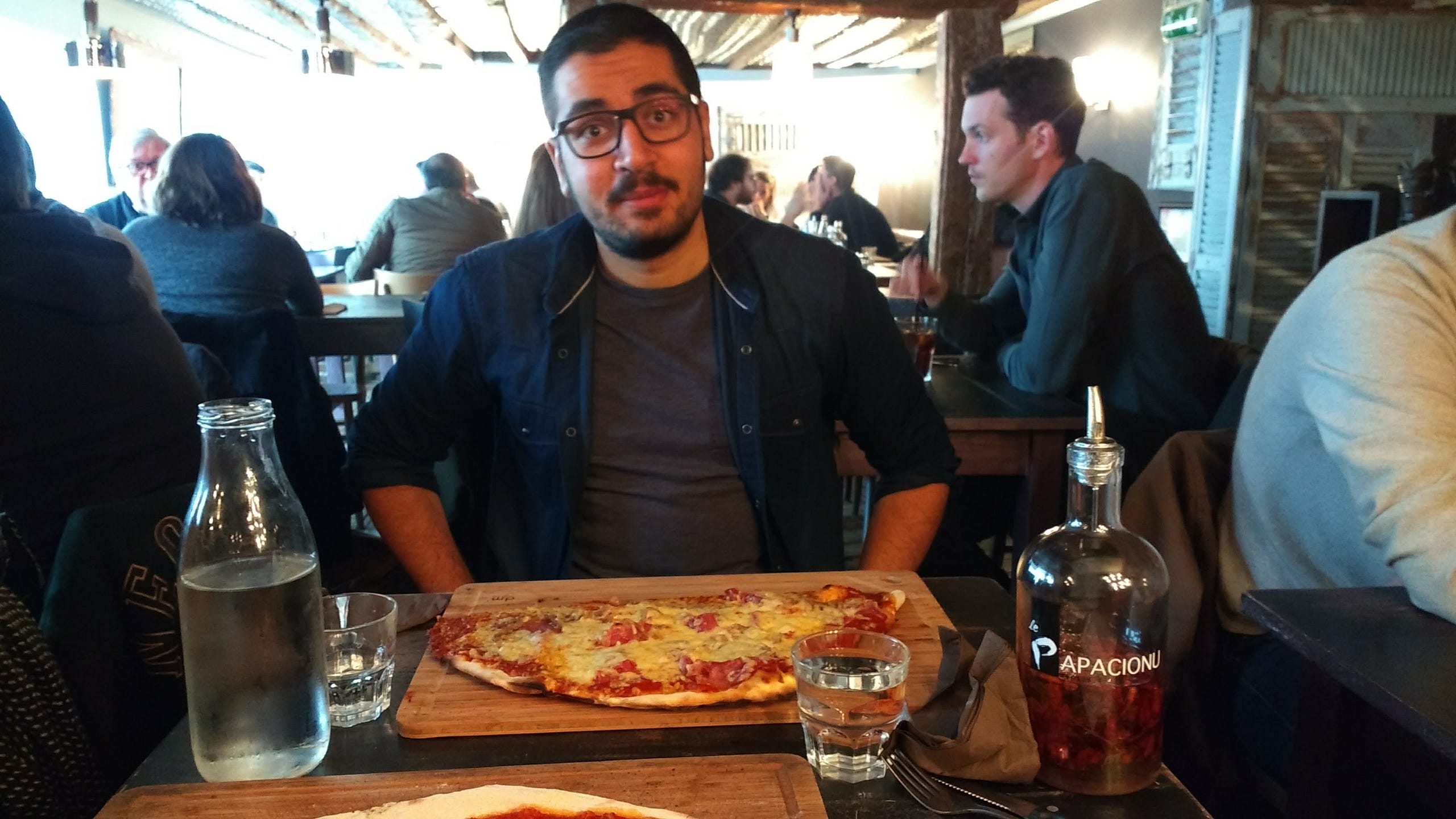
Pancetta, Mozzarella, tomatoes at Papacionu
Let’s start by who you are and what you do
I didn’t really have entrepreneurship in mind at the time, but we had a good feeling with each other and I believed in the vision
What’s your background?
I pretty much always was attracted by tech but wanted to keep it as a hobby, so I started studying finance engineering but realised after a year that it just wasn’t for me.
I then went to EPITA (engineering school) and had a bunch of maths classes. When Ecole 42 announced they were opening, I took their online tests, then went to the “piscine” (1 month coding exam that they created to onboard new students).
That’s where I discovered their pedagogy and loved it. I wanted to code. So I decided to join the first batch of 42.
How did it all start?
Jean-Charles and Théo were childhood friends and started building an SMS service to match students from top schools with jobs. The business took off quickly, and I heard about it 2 months after it started: we had a common friend, and I was curious about the project.
I didn’t really have entrepreneurship in mind at the time, but we had a good feeling with each other and I believed in the vision. So after some discussions, I jumped in!
And now, what do you do?
I work on business/tech/product. My main goal is to make a stable product and give it the best UX possible for both internal and external users. I’m basically making the link between all the components of the company that are lead by tech.
We’re currently redefining the product ownership, so I can’t tell that I’m the product owner. But I’m making sure every product process works smoothly with the tech side.
Has your job changed since the beginning?
At the beginning I was building the product from scratch, being the only developer. Hands on, coding 24/7. Now I’m mostly a manager, I almost don’t code anymore.
I’m also putting a lot of thought into the product, as it needs to evolve as we grow and we need to add some processes to stay ahead of the game.
Tech concerns
I never enjoyed coding more than I do in Go
What’s your stack and why?
We’re on a Go backend with AngularJS on the front-end, and we run on Google AppEngine. We know the whole package is quite unusual but it works very well!
One of our mentors is a Google Expert (Didier Girard, CEO at SFEIR), and that’s why we got into AppEngine, Go and AngularJS, as we basically got free training. I never enjoyed coding more than I do in Go. It’s smooth and sweet.
Have you had to change that stack, or are you planning to?
At the beginning, it was a bit hard because Go didn’t have a good documentation nor a strong community. Now, it’s grown into a widely used language so things are a lot easier. I must say that at the beginning it was mostly about playing with a new technology, but it paid off.
We’re going to have to add some mobile features. We’re thinking progressive webapps.
On the frontend side, we’ll have to change Angular someday, if we want to keep hiring the best people. I’ve heard VueJS is the growing front-end framework nowadays, so we’ll take a close look.
Have you ever faced a crisis, technological or not?
Not really, just small problems all over the place. When you’re the only dev and there’s a high growth in the company, you don’t really take time to test everything, and by going too fast you might end up building unstable parts of the product.
Now we have quite a lot of processes when we push code. We don’t have automated tests yet, but we will someday, as our new developers just freshly arrived!
Your CTO life
I’m basically a buffer between the tech team and the rest of the company
What’s your hardest task?
Putting product development processes in place. There’s a lot of ideas coming from all around the company, and we need to shape them to make sure that the “who owns what” question is answered — which is hard when the structure keeps evolving.
My hardest part is to scale the team: working with 2 people is not the same as working in a group.
Your most important responsibility?
Making sure the product is stable and that information flows well between business, product and tech teams.
I’m basically a buffer between the tech team and the rest of the company: when some things are not technically doable or worth doing, I’m the one that needs to explain it to the rest of the company.
Would you change anything you did since the beginning of Crème de la Crème?
There’s a lot of things that are not perfect.
But it’s part of the experience, and that’s where you learn.
The people
Can you describe your tech team in a few words?
Atypical, with very different and eclectic backgrounds. Everybody is passionated, ambitious and with a drive, which makes the team great. We see each other as each being some sort of entrepreneur.
When I talk about atypical backgrounds, one of our developers is a former player in the French US Football team, and then went to a business school. He became an IT recruiter at Michael Page but didn’t really like it, so he became a professional online poker player, which made him travel a lot.
After a while he met somebody from my school (Ecole 42) during one of his travel in India and started coding. This crazy experience gives him so many unique qualities that you wouldn’t find in a “regular” engineering profile!
So is there anything you’re looking at when hiring? Atypicality?
I haven’t hired enough people myself to be able to answer this question well. I base everything on the feeling with the person: I show the code the new hire would be working on, and start the discussion.
I mainly want to see if they come up with ideas and get involved quickly in the project. You won’t join only to type on a keyboard, the entire tech team takes part in the product building process.
Jean-Charles (one of the cofounders) asks himself: “Could I go on vacation with them ?” — which I think is a great question to ask.
Vision
Where do you see the company in a few years?
We’ll be in a few European countries.
We would also like to be seen more as a tech startup than we currently do. For now, it’s more about the business, but the product is taking a bigger part every day, and needs to be put in the spotlights.
What are the biggest problems you might face?
Growth is an exciting but dangerous thing. I think the biggest danger any growing company faces is managing their growth.
We won’t be an exception, we’ll have to be careful, as we are planning a really nice growth curve!
Stay up to date with the pizzas !