Learn how to learn — Pascal Corpet (Bayes Impact)
Bayes Impact is an organization that deploys data science teams on solving big social impact challenges.
- Founder: Paul Duan
- Founded: 2014 in the US, French branch in 2016
- Funds raised: None, Bayes Impact is a NGO :)
- Employees: 11 in France, 10 in the US
- Tech team: 6 people
What’s on your pizza?
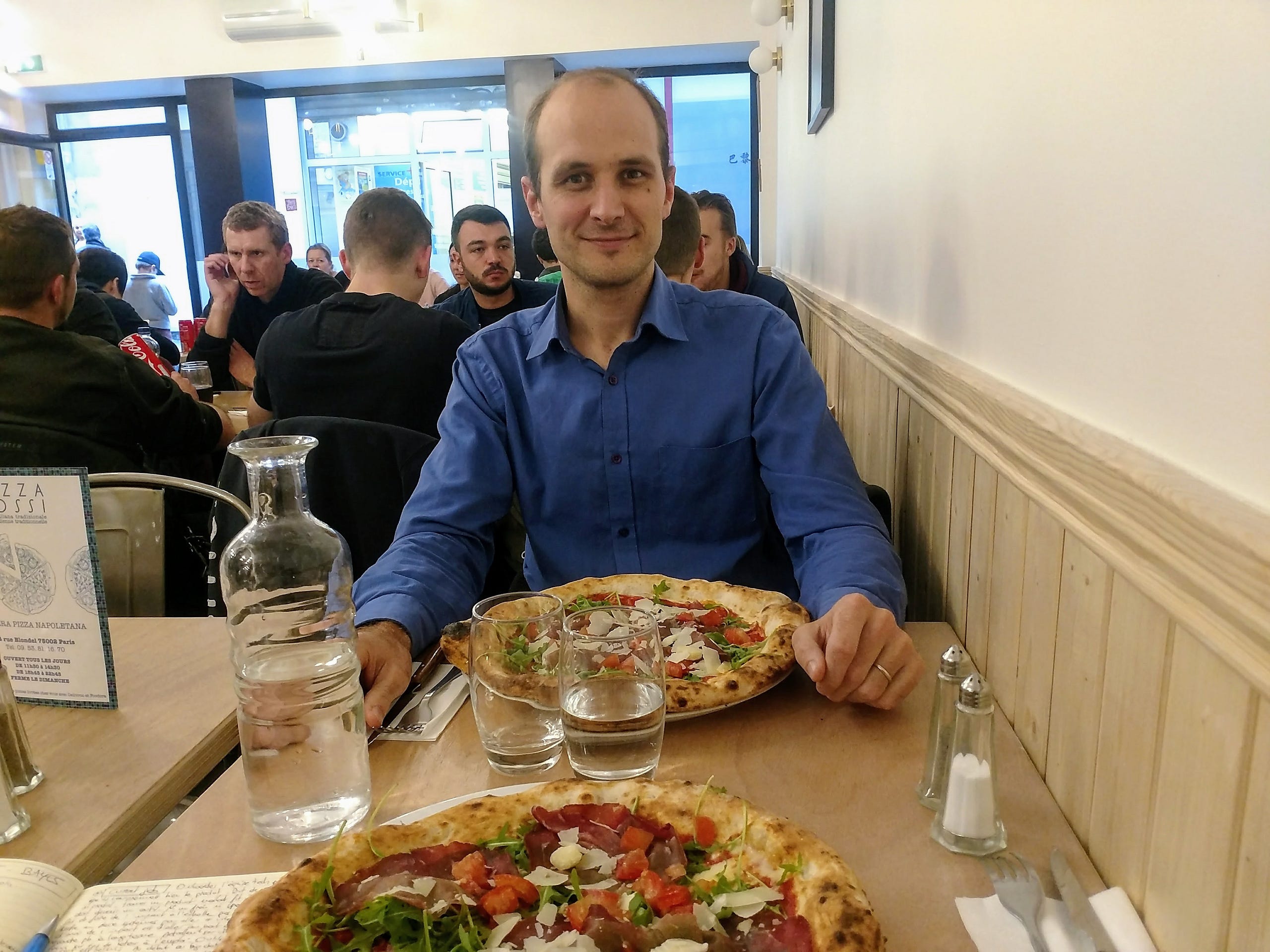
Pizza Valtellina at Pizza Rossi
Let’s talk about you
We want to build systems to go faster, and go deep enough to have a long-term impact
Tell us a bit about your background
I was a software engineer and graduated from Polytechnique/Telecom ParisTech. I worked for a while in the public sector, then for 5 years at Google Maps in Zurich. I ended up quitting to follow my wife in Lyon, where I quickly met Paul after networking for a bit.
I’m passionate about technology and human management. I was lucky to work in very different environments, from the public sector to Google — where the humans are the most important part of the company. As a manager, if you feel like somebody that is underperforming has a chance to grow, you have to make everything in your power to make it work.
How did you join Bayes Impact?
I met Paul as I was networking to find a new project. He had started the concept in the US — tech for good. The world is turning more and more towards data and unemployment is a bigger problem than ever. Paul was getting traction with politics and press and was trying to assemble a team in France.
The project is aligned with the way I work and live my life. Social matters have always been important to me — I always thought that I would switch from a software engineer career to another role in a Social organizations at one point in my life. I didn’t think it could have been so early and that I could actually mix both.
Also the project was the perfect way to put in action everything I had learnt from my past experiences in human management and pure tech. Paul is quite amazing but was still quite young (he still is!), and I thought I would have a voice and an impact in the company.
What is it, to be a CTO in a NGO like Bayes Impact?
Today my job is two folds: build a product that finds a product-market fit on one side, and on the other, build a strong technical team so that we can take on more challenges in a year or two. Technology needs to just work so that it’s never the bottleneck in our execution.
If we want to scale the impact we can have, it needs to go through innovative technology. We want to build systems to go faster and go deep enough to have a long-term impact.
Right now, we’re focusing on tackling unemployment issues. We use startups’ tools to be innovative and flexible. At the beginning, we were using only big-data technologies on data coming from Pôle emploi (note: the French government unemployment agency) but did not find enough insights to build a product.
So we pivoted to a mix of human and machine approach.
Has your job changed since the beginning?
It’s changing right now, as I tend to focus more on hiring and onboarding than I used to. For the rest, not really — I’ve always been involved as deeply in the human part of the job than the technological side.
To give you an example, we just had 3 people that joined with very different backgrounds. Onboarding them on our technical stack as well as in our team requires most of my time and dedication. Tailoring an onboarding project for each of them, adapting the difficulty as well as collaborations with other members of the team with their pace: that takes a little management effort.
My goal is to quickly produce less than 50% of the commits without slowing down.

Let’s talk about tech
I’m more afraid of not seeing a crisis coming than having to solve a visible one
Can you describe your stack?
It’s not really set in stone, to be fair. I’m not adamant on our choices — many were made before I joined — and we might still change some of them as we go.
Our front-end is in React, we’re running on Python/Flask on Docker hosted on AWS. Our static files are stored on OpenStack on OVH and we use Pandas for data-science purposes.
Each of our layers is very independent and can be rebuilt if necessary. We moved to AWS in production 2 weeks before our official launch, but that was quite easy because we run on Docker.
Can you describe a crisis you had to manage?
Our main tech “crisis” had very little impact. The production environment broke for about 6 hours during the night and we think that we lost about 20 users.
On the human side, we had a more serious one as the original CTO, based in the US, left the company in a quite complicated way. There was a misalignment between the founders and clarifying it was not easy. He and I overlapped for about a year when I was still a software engineer. I only became CTO a few months after he had left.
I know we’re heading towards a major crisis, but if I knew what it was, there would be no crisis! I’m more afraid of not seeing it coming than having to solve a visible one.
The CTO Life in a NGO
Making sure the team has a good work-life balance
What’s your biggest challenge?
Making sure the team has a good work-life balance. I’m married with 5 kids, I take all the vacation I can, etc. But when I’m at work, I’m fully focused and I go fast.
It’s quite hard to tell people we’re a cool company with a healthy lifestyle but when it comes to work, you really have to work hard. People that stay too long in the office or don’t work fast enough can make things uncomfortable from time to time, so I’m trying to be as clear as possible on this side.
Is there anything you’d have changed since the beginning? Something you would do better if you knew where you are now?
On the product side we lost some time trying to get aligned with everybody in the team. It took us a while to gather everybody’s ideas to get going, because it’s always better to try a few ideas to the maximum than trying a ton without giving you enough firepower to make them work. Now, it’s Paul (the CEO) that decides which ideas we should pursue and people are OK with it.
I’m very inspired by the “Disagree and commit” spirit that Jeff Bezos holds at Amazon. Make you think everything from the start everyday, without taking as granted what’s already there.
Let’s talk about your people
The company needs to sell its CTO well
What’s your team like?
Everybody is passionated by social impact and very intellectually honest. We don’t work for money here and vanity metrics don’t live a long life — even if we sometimes use them externally, of course.
There’s a lot of humility in the team, and strictly no arrogance but there’s a real drive to make the team grow, a hunger for getting more things done. As an example, we hired one of the engineering managers at Deezer that never used any of his past to make a point, but only by putting his skills in action.
What are you looking for in a new hire?
I’m trying to see who the candidate wants to be and how they want to grow. If they are only here to ramp up on some specific skill and move on, that wouldn’t be really interesting for us.
I’m not looking at what you know yet, but how much you can learn. We use a few techniques to learn how to learn, and they usually work quite well.
Any tips for our fellow startups that are trying to hire good developers?
Go to technical meetups, even if it’s not your stack. You want to present your project in those meetups and be obvious about the fact that your project is the best, and that you are looking for the best developers.
The company also needs to sell its CTO well. Developers will join if they believe they can learn something from you. If the CEO keeps telling the world how great the team and the CTO are, it shows that the company has a healthy relationship between the tech team and the rest.
Vision of the future
What will be Bayes Impact, 5 years from now?
The product will be used by 50% of the unemployed people in France. We’ll also have launched in 3 different french-speaking countries, and the site will be on its way to handle full internationalization.
The platform will have pivoted to become stronger on the contribution side of things, getting closer to a Wikipedia-like experience. We ultimately want unemployed people to help each other out.
We’ll be surfing strongly enough on the success of the unemployment project that we’ll have launched 2 or 3 more projects, regarding public service or environmental issues, health, poor housing, etc.
The biggest challenges to reach this point?
We’re at risk with the reputation that the press can give us, as for a NGO any bad press can have some real impact. People don’t really understand what we do yet and think that there might be some sort of trick to it.
So we need a lot of visibility, to put our good faith under the spotlights. Having bad press could alter the morale of our team.
We haven’t completely found the product market fit yet (even if we’re getting there). I should be able to tell you a lot more about that in 6 months!
Stay up to date with the pizzas !