Professional love at first sight — Julien Balmont (Zenchef)
Zenchef is the easiest marketing and booking system for restaurants, and is an all-in-one marketing SaaS that helps restaurants attract customers and increase loyalty.
- Founded: 2010 by Xavier Zeitoun, Julien Balmont, Thomas Zeitoun
- City: Paris, France
- Funding: 8.5M€
- Company size at time of writing: 44
- Tech team: 9— CTO, Lead backend developer, 1 backend dev, 2 front-end, 1 iOS and 2 UX designers
What’s on your pizza ?
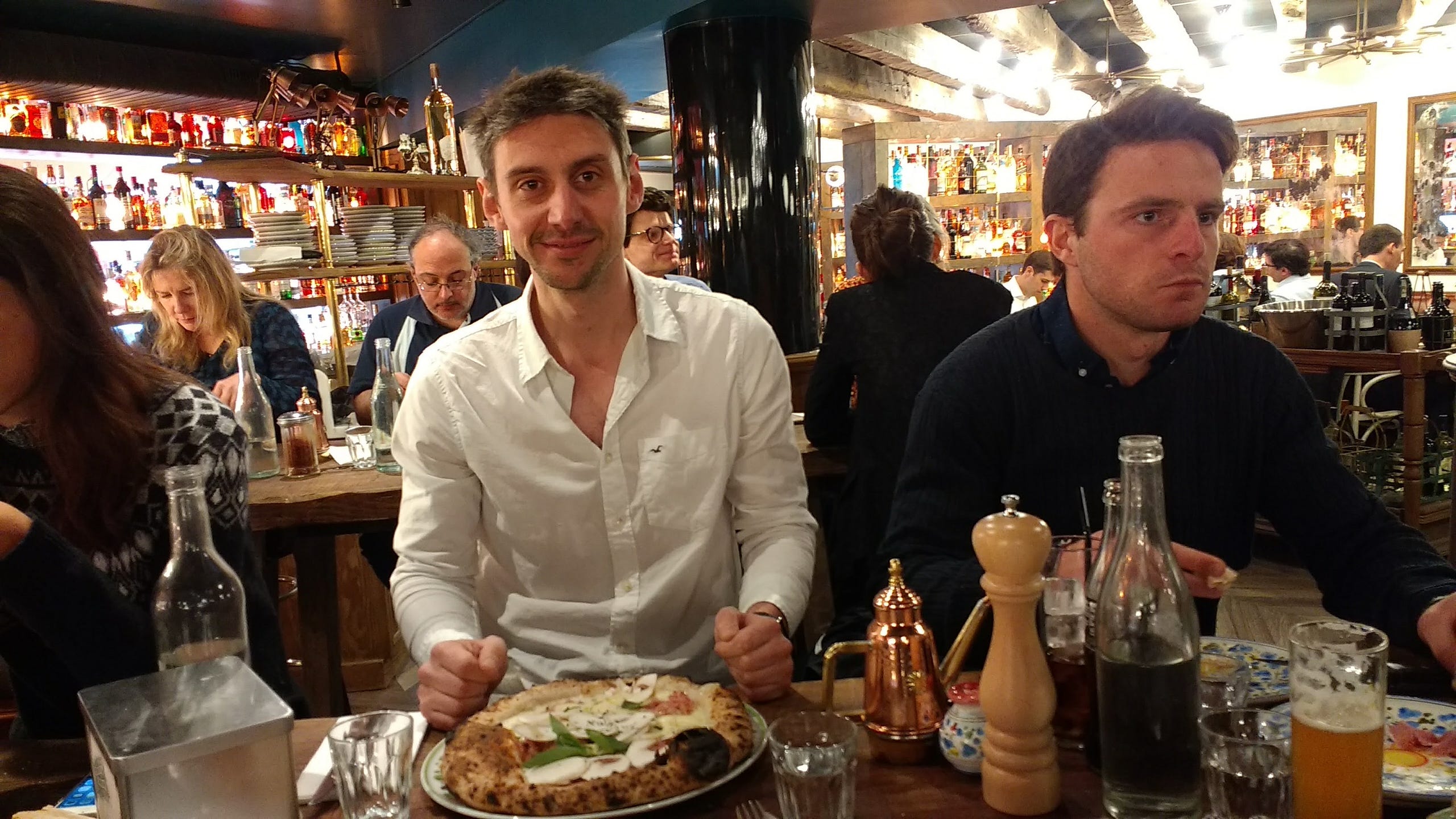
Reggina: Mozzarella, Fresh mushrooms, tomatoes, ham at Pizzeria Popolare
Let’s talk about you a bit
It was basically a professional “coup de foudre”. Love at first sight type of thing, business wise.
What’s your background?
I studied computing and worked different jobs for quite short times in services companies — one year at GFI Informatique, 2 years at Actoll, then 8 months at PSA… But I wasn’t really happy, that’s why I jumped around so much.
I then joined Serge Alleyne to build a platform to sell logos and ringtones for mobile phones, that got bought by Echovox, a Swiss company whose main business was paid SMS messaging.
A few years after the buyout they separated the payments part into a new company (Zong). At the time, the boss of this new company was David Marcus — now head of Facebook Messenger.
Zong became the main payment platform for Facebook Messenger a little bit later, and got bought 240M$ by PayPal in 2011. So I stayed at PayPal for a year, and left to build 1001Menus (which became Zenchef later)
How did you start Zenchef?
Xavier had the original idea when he discovered MenuPages in the US, which is basically a big directory of menus over the country. When he came back to France he launched pretty much the same thing here, which took off pretty quickly.
I met Xavier and Thomas through an “entrepreneurship dating” site (Teamizy). We had lunch and basically started working on Zenchef directly. It took us about 6 to 8 months to really become associates — I left PayPal a year later after working nights and week-ends on what would become Zenchef.
It was basically a professional “coup de foudre”. Love at first sight type of thing, business wise. Xavier sold me the idea really easily and we started talking about shares of the company a lot later. At first, we just started working on the project because we really had fun and were into it.
In a few lines, what’s your job now?
I manage the tech team. We’re currently searching for a Product Manager, so I’m also filling in for this part. I manage IT, software and all that stuff people need to work in the best way.
For the CRM part, we trained someone that became our Salesforce expert, so I don’t have to manage that.
About the strategy of the company, we take most decisions in a collegial manner. We try to involve as many employees as possible in any strategic decision.
How was it before?
I was alone at the beginning. So when I started needing to hire and manage people, it was all new to me. I had never done it. Exciting!
For about a year, I stopped pretty much everything else to implement a big financial tool that would manage all of our cash flows. So I delegated completely the coding side of my job and now I’m back to it about 10% of my time.
Most of my job is now about taking decisions and keeping things organized.
Tech stuff
What’s your stack and why?
- Back-end: PHP/Laravel
- Front-end: Angular, with a move in progress to React and websockets
Everything is on AWS with ElasticBeanStalk. We have a few micro-services, but not really enough for now and need to work more towards this type of architecture.
We don’t and won’t really have scaling issues, as restaurant’s growth is easily predictable — we won’t have one day 10000 unexpected simultaneous connexions because one restaurant got huge overnight.
Have you changed your stack so far?
We’re moving from Angular to React. It’s a team choice for the biggest front-end project we’re currently working on, about having a global map view of the restaurant’s tables.
One of the devs worked on it and convinced us pretty quickly that the switch was worth it. It’s also an advantage for hiring when you work on sexy technologies.
Have you ever faced a crisis? Tech-wise or not?
We had a pretty hard year in 2016, after 2 years of uncontrolled hires. The CEO wasn’t really operational either because of his focus on the fundraising, and we started having attention issues towards our customers which felt a bit left out. With 12 salespeople, we ended up having the worst month of the company in a while.
We hired a great sales manager, thinking that he could revert everything and give us a clear blue sky, but it wasn’t enough. So we realized that we needed to re-think what we were and how we worked. We sadly had to let some people go and started hiring with a real focus on the perfect fit for the company and the job to fill.
The founders now meet every new hire, which wasn’t necessarily the case beforehand, and the entire team that the person will join also meets them during the interview process. One “no” and they won’t join.
Since then, everything’s going so much better!
The CTO life
Absorbing a lot of feedback and making sure things change quickly when they need to
What’s your hardest challenge?
Being able to manage the product and improve business flows and processes to keep creating new features. For now, we can have times when the developers are available at the same time as the designers, which isn’t the most optimal.
I’m going to take coaching lessons on product management, and we also have somebody who is working on the product more on more (currently in the customer success team, but quickly growing on the product).
The lead developer will likely take more responsibility towards management of the team, so I’ll be able to concentrate a lot more on the product.
Your biggest responsibility?
Making sure people in the team are happy and that they work in the best conditions possible. This means quite a bit project management, which can be a pain if not well planned in advance.
This goes through absorbing a lot of feedback and making sure things change quickly when they need to.
If you had to change something you did since you started, what would it be?
I would ask myself a lot faster why a bunch of customers were leaving the platform. We realized that because of the uncontrolled hires, teams that used to go drink a beer after work were not really talking to each other anymore.
In a few weeks, we went from having a drink almost every day as friends, to basically nothing because we didn’t control what was happening. That’s something we won’t ever do again.
The people
Even for the most essential job in the world, hiring the wrong person costs a lot more than waiting to find the right one
Can you describe your tech team? Who are they?
They are the kind of people that don’t always like to talk too much during the day, but are always open to any subject of discussion and can crack a joke out of nowhere.
They are all really passionated people that get (I hope!) fulfilled in what they do at Zenchef. They are curious, take initiatives and that’s awesome in many ways.
Anything special you’re looking for while hiring?
Curiosity. I’m not the most organized person in the world, so I need to work with a quite independent team that knows how to solve problems. So there’s a lot of measuring the “feeling” during and interview process.
We also have a quite interesting online test that we are proud of. Some people actually try to solve the exercises without applying for a position after doing so, just for the sake of it. It includes pure tech skills, networking, data and geek culture in general. So when somebody reaches the on-site interview, they are usually already quite happy to have passed the test.
Any specific tip for startups looking to hire smart people?
Take your time. Don’t rush. Ever. Even for the most essential job in the world, hiring the wrong person costs a lot more than waiting to find the right one.
Future
Where do you see Zenchef in 2 years?
We’ll be the leading channel manager of restaurants, managing in real time all their bookings and availabilities, through all of their acquisition channels (travel agencies, etc.). Also, we’ll be international :)
The hardest problems you’ll face to reach this point?
The hardest thing will be to connect to all the platforms and partners we will need to integrate to reach the point where we can be a one stop shop for the restaurants.
We need to integrate with quite old software that currently manage the restaurants’ registers, some not even being connected to the internet.
We basically need to develop the best booking software for the restaurants first, and then go to the potential partners showing how many customers we have so that they will take us seriously and help us get integrated to their solution.
- https://www.zenchef.com/
- https://www.facebook.com/ZenchefFrance/
- https://twitter.com/JulienBalmont
- Jobs: https://zenchef.workable.com/
Stay up to date with the pizzas !