The team has complete discretion to reach their objectives — Julien Masson (SAV Group)
SAV Group is a 20 people company (size doubled in a year) that raised 6.5M$ and that edits reverse logistics SaaS platforms like revers.io and myreturn.io
- Founded: 2009
- Founder: Vincent Torres
- Funds raised: 6.5M$
- City: Paris, France
- Company size at time of writing: 20 (doubled in a year)
- Tech team: 1 CTO, 2 PHP, 6 ASP.NET Full Stack, 1 devops (hiring 1 React front-end dev)
What’s on your pizza ?
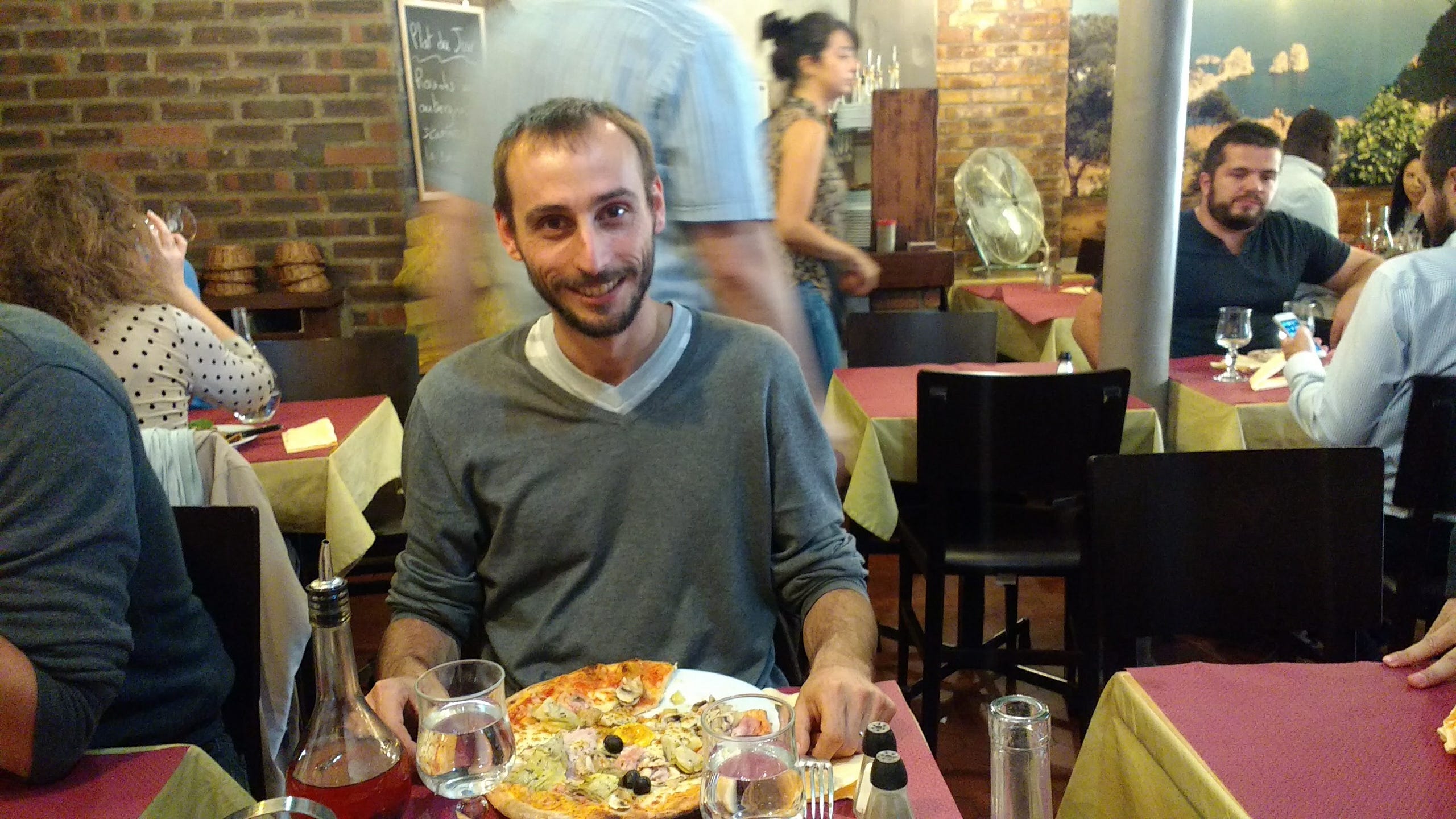
Quattro-stagioni : artichokes, tomatoes & basil, mushrooms, prosciutto and olives at Restaurant Capri
You and the CTO Job
I’m a facilitator between the company’s strategy, the product definition and its implementation in production
What’s your background pre-SAV group?
I come from a general engineering school (Mines ParisTech) and worked for about 12 years at Dassault Systems (C++, Java, JS).
I then became the CTO of Viavoo, a company that builds linguistic analysis tools for customer service platforms. I joined right after the entire tech team left, and being a CTO was a first for me!
The 2 years I spent at Viavoo were about stabilizing the platform, rebuilding the front-end in ReactJS, building APIs, refactoring the back-end into a micro-services architecture… Until I finally moved to SAV Group about 3 months ago.
How did you join SAV Group?
The company was created in 2009 with the objective of managing the reverse logistics of distributors of any size. As it was difficult to sign such customers without a product of managing reverse logistics, a B2C service called monsav.com has been created, enabling them to serve B2B. This has been a successful proof of concept for convincing large distributors that we were able to manage the complete after-sales lifecycle, building platforms for the marketplaces to handle their own customer’s returns: revers.io and myreturn.io.
I knew the former CTO of SAV Group, who left to join Microsoft. I knew the position was open and there was a quick match with the founder — he’s a young guy with a very dynamic spirit that was still a student when he created the company.
What does your job look like now?
I’ve got one principal objective: deliver a new platform that will fulfil all of our customers’ needs. There’s also a big need for maintaining the existing architecture, but it’s a bit lower of a priority in my mind.
To achieve that, I’ll have to build the right team. We already have a team so we also need to implement some processes to stay coherent on complex projects.
I haven’t coded since I started 3 months ago! It’s a big change compared to my last job, where I coded a lot. I spend 50% of my time on recruitment, and we just signed 2 newcomers — I’ll have a bit more time to work on the product.
I really feel responsible for hiring the right people and boosting the project team to have the cleanest specifications, as exhaustive and simple as possible. I’m a facilitator between the company’s strategy, the product definition and its implementation in production.
Has your job already changed since you started 3 months ago?
Actually, yes! The goal is to move from being a startup to being an industry player. That means implementing more processes, which is a word startups can be afraid of. We used to build a product for each of our customers to fulfil exactly its needs, without really looking at the big picture when it came to the architecture. Now the objective is to build a unique platform which will be used by all of our customers.
That means changing a lot of the architecture, reorganizing development resources, etc. We’re investing a lot in the tech team and tools. We used to pat developers on the shoulders and ask for something to be done in the next hour — we can’t do that anymore and are currently establishing processes.

Tech concerns
We set up tech objectives, but the team has complete discretion on how to reach them, as we have a lot of seniors that know what they are doing. The important part is not how we do, but what and why we do it.
What’s your tech stack and why?
The platform is in ASP.NET, historically, way before I showed up. I didn’t want to shake the entire tree so we kept the backend in .NET, as we already have resources in house who master this technology.
We want the new platform to be completely scalable, because we have big customers in mind that will likely join soon. The most important for my team is to be able to manage the infrastructure like code, using tools like Terraform.
We use continuous deployment with a strong test suite and everything runs on a micro-services architecture. The important part is not how we do but what and why we do it. We set up tech objectives, but the team has complete discretion on how to reach them, as we have a lot of seniors in the team that know what they are doing.
We’re using React for the front-end in the new platform, but it’s a tricky part because we’re building a lot of white label sites for big customers.
Have you had to change this stack or are you planning to?
The old stack was not designed to address all customers in one place, so we’re just completely replacing it with the one I just described. I would have preferred to be able to cut the refactoring in pieces and make the switch component per component — but the differences between the old architecture and the new one force us to do a “one shot” switch.
The old architecture reached a point where is was just too costly to make any change because we could break anything in areas we weren’t even aware of.
Our goal is to define the minimal viable product for the new platform and ship it to production as fast as possible, and then iterate on it. That’s our best bet at reducing the risks linked to switching.
The CTO life
Applications have not been updated over the years — which make it basically impossible to do so now because the update cost is too big and implies too much risk of breaking everything
What’s your biggest challenge, right now?
Up to recently I would have answered hiring, but we just secured to new hires, I’m excited! We still need to find one more. The biggest challenge is to estimate when the platform will be ready for production, and it is no easy task…
For now it’s quite blurry, we still need to gather more information to understand the full picture and be more precise, but as we work with Agile methods, it’s hard to set deadlines in stone. Things are moving quickly and can create tensions between the IT and project departments, most of the time regarding planification issues which is a shame !
Your most important responsibility?
The big responsibility we have is to keep things secured. We are building an infrastructure that handles personal data the right way. There’s a new law (GDPR) coming up about manipulating personal data that can really financially impact our customers and we want to help them to do it the right way with our products.
It means that security is really at the heart of our processes and practices, and we see that as an opportunity more than a constraint.
Anything you did that you regret, that you wish you’d done differently?
The infrastructure is quite old and some old choices can make things painful today.
The technical debt has accumulated up to a point where it just became easier to start fresh. The goal is to build a platform that will stay over time and stay up to date as much as possible, with a long term vision. Not really in ‘startup mode’ anymore!
Humans of SAV Group
If you’re not ready to invest in humans, you won’t get the right people and will spend ages trying to convince people to join
Describe your tech team in a few words
We all have quite different profiles. A few seniors got hired recently, with a goal of building a core senior team that’s rock solid. Other profiles are a bit more junior, and we have one apprentice with 2 years of experience.
The seniors come from bigger companies, banks or used to be independent. The team gets along very well, and can show a bit of a childish ambiance — playing video games and nerf wars from time to time. That might be linked to the fact that the CEO is still quite young himself! It creates a good balance between work and fun.
Anything specific you’re looking for when hiring?
Does the person really understand what we’re trying to achieve, the ambition and the why? You really need to share our objectives to be able to join the team. We’re searching for autonomous people that can be operational quickly. Our employees have higher production capacity than most people.
We test the tech knowledge and culture on the phone up-front, and then they come half a day in the team to work in peer-programming with the developers.
This process makes it quite hard to get people to arrive up to the last stage of interviews, but usually when we extend offers, they get accepted.
Any tips for our fellows CTOs regarding hiring?
Prepare a budget! If you’re not ready to put the money necessary, you won’t get the right people and will spend ages trying to convince people to join, making everybody lose their time.
But you need first to have a project which will inspire people, with possibility to use latest technologies, and a good work environment.
Future
Where will SAV Group be in 2 years?
Today we are leader in France, we’ll be leader in Europe.
Any upcoming challenges?
To reach this point we’ll need to build the new platform and be able to deliver it on time. We’ll also have to get a real sales organization going to be more agressive while conquering the market.
Stay up to date with the pizzas !