We made all the mistakes during the 2000’s internet bubble — Benoit Hediard (Agorapulse)
AgoraPulse is an affordable, all-in-one, self-service Social Media CRM platform for SMBs and agencies.
- Founded: Affinitiz (2000) / Agorapulse (2011) by Emeric Ernoult, Benoit Hédiard
- City: Paris, France
- Funding: 250k$ seed in 2012 (considered bootstrapped)
- Company size at time of writing: 34 (distributed: 11 in France, 9 in the USA, 2 in the Ireland, 1 in Switzerland, 1 in Czech Republic, 2 in Slovakia, 4 in Buenos Aires, 2 in Mexico, 1 in Brazil, 1 in Malaysia)
- Tech team: 11 (CTO, 6 Full-stack devs in Paris, 3 in Buenos Aires, 1 in Prague)
What’s on your pizza?
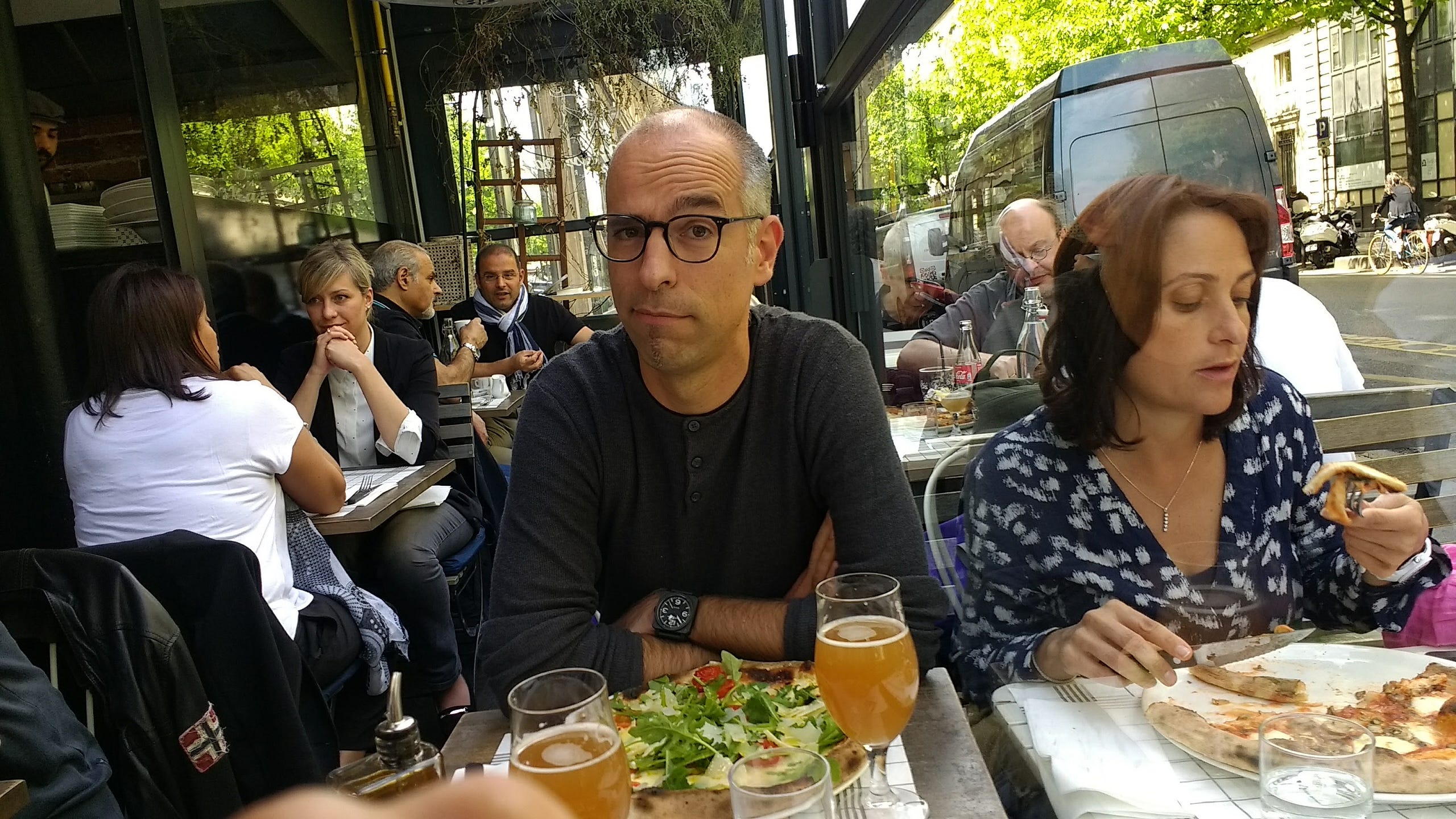
Crocantina: mozzarella di bufala, cherry tomatoes, arugula at La Massara
The CTO
In the middle of the tech bubble of the 2000s, we made a lot of mistakes. There were no accelerators, forums or meetups to help us. The only way to learn was to hit the wall, and we hit many.
What did you do before Agorapulse?
I studied Mechanical Engineering, with a specialization in CAD/CAM (Computer-Aided Design & Manufacturing) and had my first experience in India for about 1.5 years. When I arrived in Paris in 1999, my goal was to work in web or video games, which made me not want to go back to the industry world.
I was lucky to join PixelPark, one the biggest European web agencies at that time where I stayed about a year. It was in the middle of the 2000’s internet bubble, where money was flowing, and the company IPOed.
I basically learnt everything on the field there: I started as a developer, and moved to IT management in a short time.
And then you started Affinitiz?
It was in the middle of the 2000s that we started thinking about Affinitiz (note: later became Agorapulse), and at that time, everybody was looking for crazy ideas (and not really viable businesses…).
With Emeric, we wanted to concentrate on a community-oriented B2C business, on 5 themes: family, friends, associations, alumni and passions. It was the first time an online community would be anchored in real life, in a world where Myspace was prevalent.
We slaved away for about 10 years, having to take other jobs on the side to live. We ended up pivoting from B2C to a B2B business/agency model, where we sold our community (or social network) platform as a white-label product to brands. At the time, we made a lot of mistakes. There were no accelerators, forums or meetups to help us. The only way to learn was to hit the wall, and we hit many.
In 2007–08, Facebook started becoming big (killing MySpace) and brands started to get interested into developing a presence/audience on THE social network. We hung on to our idea of forming communities on our platform for about a year to keep our market share, but ended up dropping it as we saw that it wasn’t really possible.
So we moved towards Facebook apps development, where the market was strong. We build a social media management platform based on apps, that we ended up launching in 2011 — welcome Agorapulse!
The main idea was to help brands to grow and qualify their Facebook audience through Facebook apps, with marketing campaigns (quiz, sweepstakes, photo contests, etc.). We made the mistake of focusing too long on that apps market, which is pretty difficult to grow on the long-run, because of high churn rates.
We finally made the move towards full social-media management, including Twitter and family, and things started taking off from there.
So now, after the bubble and all these waves, what’s your job like?
We developed the platform with 3 to 4 core developers that knew all of its intricacies. Now that the tech team has grown to 11 people quite fast, my job is to implement processes to facilitate everybody’s work while not being restrictive, and it’s great to be able to delegate and rely on this great core team!
It’s quite hard to find an equilibrium, as there is no right or wrong: everything depends on people’s personalities. Before the growth, everybody was fully autonomous — we can’t really afford that anymore.
So my job now has more management in it, on-boarding new people, etc. I code a lot less, but I still want and need to. The rest hasn’t changed that much I must say.
Tech
We sometimes go through upgrade tunnels to avoid piling up our technical debt.
What’s your stack? Make us dream.
We work on anything JVM-based, especially with the Groovy ecosystem, which is great. It gives you the best of both worlds: the expressiveness and agility of web frameworks like Ruby+Rails and Python+Django, while giving you access to the power and richness of the Java universe.
We use Grails as our main framework to build our APIs and workers, and Vertx for real time stuff. Our front-end is currently on Angular 1, but we’re moving it to Angular 4.0. Same thing with our mobile apps which are built in Ionic, that we’re upgrading from v1 to v3. We sometimes go through upgrade tunnels to avoid piling up our technical debt.
When we go for a big upgrade like this (front-end complete rewrite), it’s because the product needs it, we really pushed AngularJS to its limits. If the product upgrade is big enough, then sometimes it’s just better to rewrite everything in a fresh an up-to-date stack. It also helps a lot for hiring!
Have you had to change your stack since the beginning? Besides the upgrades.
The first POC (note: Proof of concept) was in Coldfusion, which is a dinosaur now, but it was the first scripting language for the JVM. We moved to Groovy and Grails quickly.
We’re early adopters of anything linked to AWS — so every time they release a new service that relieves us from devops work, we tend to switch on it. I think we use at least half of their services.
One of our big moves was to switch the storage of our data from a monolithic relational DB (AWS RDS/MySql) to NoSQL one (AWS DynamoDB) a few years ago. It has a lot of limitations, especially for querying, but it removed all the scaling issues that we were starting to face. One of our best upgrade tunnels so far!
Any crisis you had to solve?
The site went down twice without us being able to do anything, which is the worst feeling in the world.
- Our Facebook app got randomly banned by what we believe was a routine spam check of some sort. Customers couldn’t connect to their platform, the site was totally unusable. At the time, we were too small to make any noise towards Facebook, so we had to wait a day or two until they re-enabled our app. Now, we’re an official Facebook partner so that can’t ever happen again!
- AWS Ireland region went down about a year or two ago. Same deal, nothing we could do but wait. That’s where crisis communication management is vital — if you let your customers know soon enough that things are out of your hands, when it comes back, they just forget about the incident.
Everyday life at Agorapulse
The hardest part is to build a product that’s better than our competitors that raised between 50M$ and 250M$
What’s the hardest thing you’re working on?
We’re releasing the v6 of the site soon, which is basically revamping the front-end entirely. That puts quite some pressure on the team.
In a more general way, the hardest part is to build a product that’s better than our competitors (mainly Hootsuite and Sproutsocial) that raised between 50M$ and 250M$ and have hundreds of employees.
We’re confident we can play in the same league while being so much smaller.
Your most important responsibility?
I need to be the best conductor possible. My job is to facilitate the team’s work, and to make sure we don’t screw up the tech architecture.
That means tools, processes, environment, etc.
Would you change anything you did since the beginning?
From 2000 to 2010, we made all the mistakes that were possible to do. We didn’t have any external mentorship, so you just learn by doing.
In the beginning we pivoted from the Facebook apps model because the churn was humongous, but it took us about a year to really feel the impact — most of our acquisition is organic through content marketing and SEO, so it takes a lot of time to change it. I wish we switched faster.
Another mistake I made and that a lot of young entrepreneurs usually make: underestimating the other side of your company. Marketing people tend to think that you can sell a so-so product to anybody if you’re good enough at selling, while techies think you can lay down and watch your awesome product getting adopted without you doing much on sales & marketing.
It’s the key to success, finding a good balance in between Marketing & Tech, it’s really a 50/50 job!
The people
Each team is very autonomous in their hires, as we completely trust the managers and teammates to make the right decisions
Can you describe your team?
We have a few core values at Agorapulse:
- Love a job well done
- Thirst of knowledge
- Friendliness, conviviality and humbleness
We have a great team spirit, even while being so spread out around the globe. There’s a real cohesion in the team because of the personalities that fit together.
Anything you’re looking for when hiring?
It’s pretty hard to judge the technical level of the candidate during an interview, especially for junior developers. What really matters to us is the personality fit and then, github/stack-overflow activity and knowledge of the stack ecosystem. A candidate will meet the entire team he or she will likely work with before moving further.
Each (Marketing or Tech) team is very autonomous in their hires, as we completely trust the managers and teammates to make the right decisions. We very rarely missed a hire this way, maybe once.
A hiring tip for our fellow CTOs?
Keep your stack fresh to stay attractive. And you want to gravitate in the ecosystem where the people you’re searching for are. Each stack has a philosophy behind it, so pick yours!
Vision
Where are you in 2 years?
In SaaS, you have to grow to reach several phases, based on your ARR (Annual Recurring Revenue):
- Initial Traction (up to $1M ARR)
- Scaling (up to $10M ARR)
- Market Dominance (up to $100M ARR).
We are currently in the middle of the scaling phase with 100% growth year over year.
Jasom Lemkin from Saastr says that “Inevitability in SaaS comes around $10m in ARR”. Our goal is to reach this “inevitability” and to pursue the goal of being a market-leading product in the Social Media Management space.
Any ambushes ahead?
Maintaining the team’s cohesion and good spirit is a must. The bigger you get, the harder it is to keep the family spirit around.
We’re having our first offsite where everybody will fly to Paris to get to know face to face!
- https://www.agorapulse.com
- https://twitter.com/benorama
- https://twitter.com/AgoraPulse
- Jobs: https://www.agorapulse.com/work-for-us
Stay up to date with the pizzas !